I founded my company with adminster.
I am very satisfied!
Will now continue to work with them.
M
Michael Dettwiler

Sooner or later, many business owners, executives, and self-employed individuals face the question: Should the car be registered to the company or kept as a personal vehicle? This decision has not only practical implications but also tax and accounting implications.
Before examining the tax differences, there is one key question to consider: When can a vehicle be classified as a business vehicle?
A vehicle may be classified as business property only if it is used primarily for business purposes (more than 50%).
If this requirement is not met, the vehicle must remain part of personal assets and may not be claimed as a business expense.
This distinction is crucial, both for tax purposes and from an accounting and value-added tax perspective.
The personal portion of a business vehicle is subject to value-added tax. This means:
The following new rules apply to personal vehicles used for business purposes:
The important thing is:
When a vehicle is purchased through the company, it becomes part of the company’s business assets, is capitalized as a fixed asset, and is depreciated over its useful life. This requirement is governed by Art. 959 of the Swiss Code of Obligations (OR), which stipulates that assets must be recognized on the balance sheet as soon as the company has the right to use them and expects to derive future economic benefits from them.
The valuation and depreciation of such assets are governed by Article 960a of the Swiss Code of Obligations (OR), which stipulates that assets may be recognized on the balance sheet at no more than their acquisition cost and may be depreciated over their useful life.
Another way to use a vehicle for business purposes is through leasing. It is important to distinguish between different types of leases: In a so-called operating lease, the vehicle remains the property of the leasing company and is generally not capitalized as a fixed asset. The lease payments are recorded as an expense. In a finance lease, on the other hand, the vehicle may be capitalized on the balance sheet.
The major advantage of a company vehicle is that many of its costs are considered business-related expenses and are therefore tax-deductible.
These include, among other things:
These expenses reduce the company's taxable income.
In addition, for business vehicles, input tax on value-added tax (VAT) can often be claimed—both at the time of purchase and for ongoing operating costs—provided the company is eligible for input tax deduction.
Since a company vehicle is usually not used exclusively for business purposes, the tax authorities require an adjustment for personal use. This so-called personal-use portion is considered a benefit in kind, is added to income, and must be reported under section 2.2 of the wage statement.
In practice, the private share is usually calculated as a flat rate. Since the adjustment in 2022, the private share has been:
0.9% of the vehicle purchase price per month, plus VAT starting in 2026.
, but at least CHF 150 per month.
Vehicle purchase price: CHF 54,000, including VAT
Monthly personal contribution:
0.9% × 54,000 = CHF 486.00, including VAT
Annual personal contribution:
CHF 5,832
This amount is added to the user's income and taxed accordingly.
If the purchase price of a company vehicle exceeds CHF 120,000 (excluding VAT), the vehicle is generally considered a luxury vehicle for tax purposes. In such cases, the private-use portion may be increased by an additional luxury surcharge, resulting in a higher taxable private-use portion.
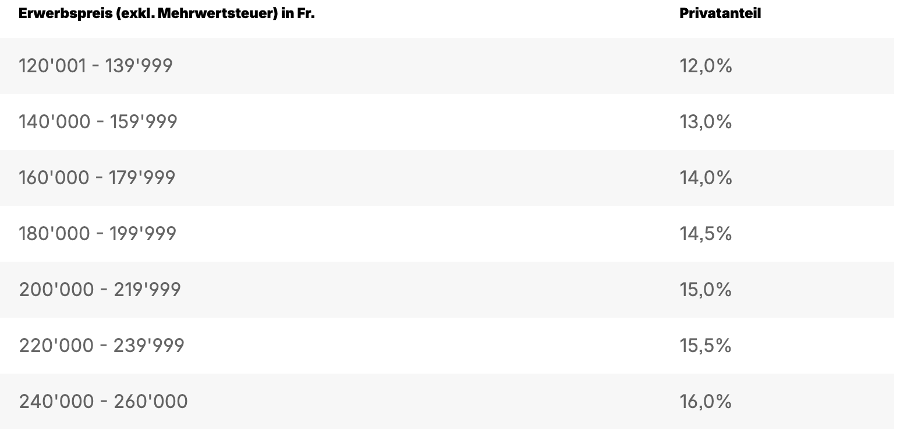
Alternatively, the private portion can also be calculated based on actual usage. This involves keeping a detailed logbook in which all business and private trips are documented. This method can be particularly useful if the vehicle is used primarily for business purposes and the actual private portion is significantly lower than the flat rate. However, the administrative burden is greater, which is why the flat-rate calculation is often used in practice.
The alternative is to keep the vehicle as part of one’s personal assets and claim business-related travel expenses. In this case, for tax purposes, the car does not belong to the company but remains entirely part of the individual’s personal assets.
For business trips, however, a flat rate per kilometer may be charged. Many companies use a flat rate of about CHF 0.75 per kilometer. The exact amount is usually specified in the company’s expense policy.
It should be noted that the tax recognition of the mileage allowance generally falls under the jurisdiction of the cantonal tax authorities. This means that the cantons determine which rates are considered tax-deductible expenses. If a significantly higher allowance is paid, the excess amount may be classified for tax purposes as part of wages or a benefit in kind.
The mileage allowance generally covers the following costs:
For the company, these expenses are generally considered business-related expenses, provided they are incurred in accordance with an approved expense policy.
Advantages
Disadvantages
Advantages
Disadvantages
A company vehicle is often a good idea when:
A company vehicle can also be tax-advantageous for businesses that regularly visit customers or have field sales operations.
A private vehicle may be a better option if:
This solution is often less administratively burdensome, especially for small businesses or sole proprietors.
The choice between a company car and a personal vehicle depends heavily on one's individual situation. Among other factors, the following are decisive:
Careful tax planning can help you avoid unnecessary costs and find the best tax solution.
There is no one-size-fits-all answer to whether it is better to register a vehicle through the company or privately. Both options have tax advantages and disadvantages.
Entrepreneurs are therefore advised to analyze their individual situation together with their fiduciary. This will help them find the solution that makes the most sense from both a tax and economic perspective.
Contact us today—we look forward to speaking with you.